
When a business sends a text message to a customer, there’s more happening behind the scenes than most people realize. With all the new rules and fees around 10DLC (10-Digit Long Code), it helps to understand who does what—especially when your money is on the line.
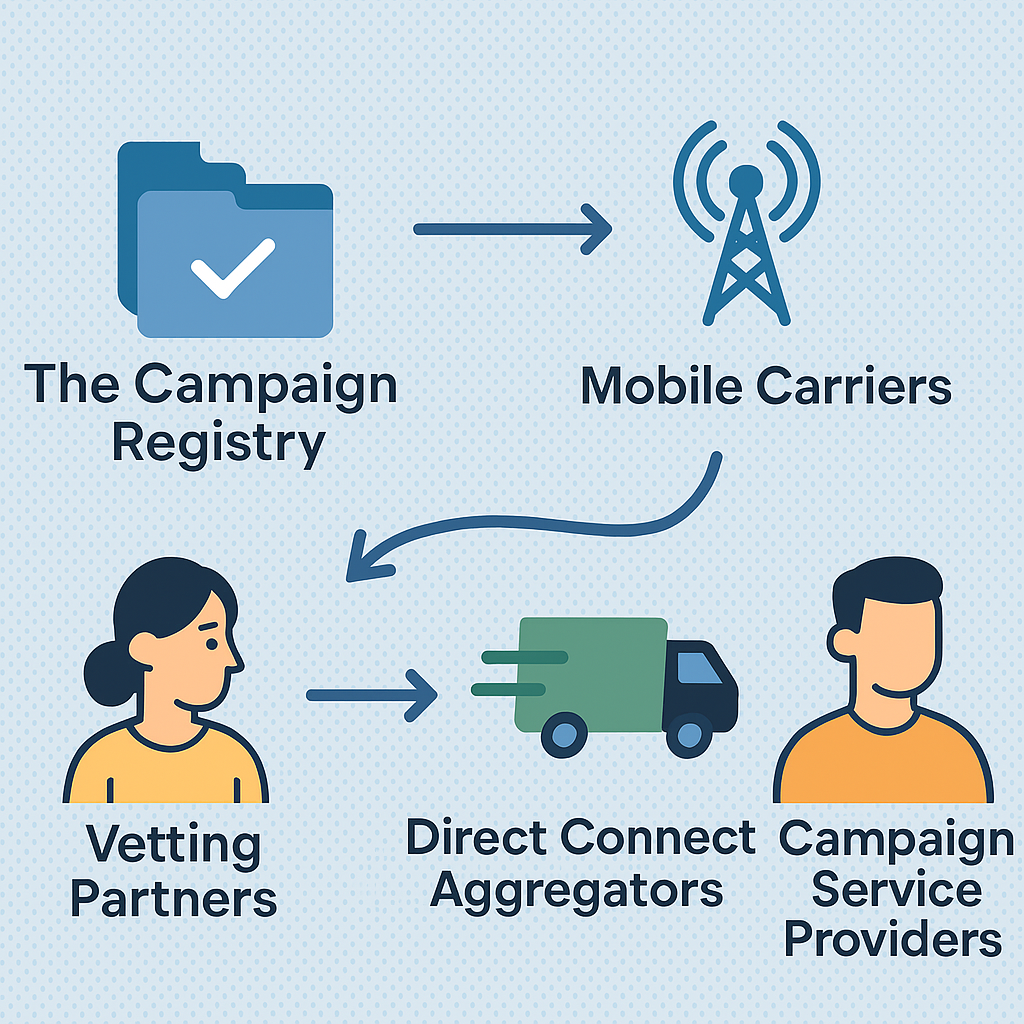
Two of the most important players are TCR (The Campaign Registry) and DCA (Direct Connect Aggregator). Here’s what they are and how they work together:
TCR: The Campaign Registry
TCR is like the traffic cop of text messaging. It doesn’t send messages. Instead, it:
- Registers your business (called a “brand”)
- Approves the type of messages you want to send (called a “campaign”)
- Assigns a unique Campaign ID to your messaging activity
Mobile carriers (like Verizon and AT&T) use TCR’s data to check if your texts are legit.
DCA: Direct Connect Aggregator
A DCA is the proverbial delivery truck. It’s a company that:
- Sends your text messages to the mobile carriers
- Makes sure everything flows smoothly and follows the rules
- Works with your service provider (also called a CSP) to get your texts out
Think of the DCA as the one physically delivering the messages, while TCR just keeps the logbook and controls who’s allowed on the road.
How They Work Together
- You (or your texting provider) register with TCR.
- TCR approves your brand and campaign.
- Your DCA uses the campaign ID and delivers your messages to phone carriers.
- Carriers validate each message against the TCR data to ensure it complies.
| Role | What They Do |
|---|---|
| TCR | Registers brands and campaigns |
| DCA | Sends the messages to carriers |
| Carriers | Deliver to phones & enforce rules |
Why it Matters?
You pay fees to TCR for the right to send messages. But if your DCA or CSP doesn’t set things up right—or if your registration is rejected—you still get charged. That’s why understanding these roles is essential.